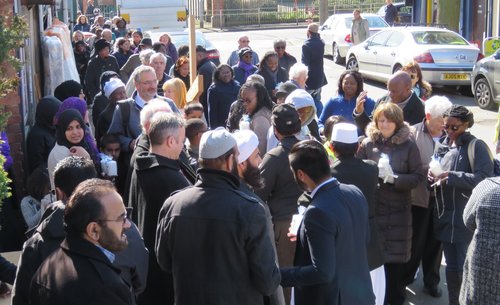
A Britain First (BF) demonstration in June 2015 brought similar mobilisation by the churches. On that occasion church leaders first wrote an open letter and then formally met BF leaders to ask them not to come to Luton. Subsequently as the demonstration went ahead similar work took place to earlier EDL events. Britain First came back to the town unannounced in early 2016, and on both occasions we acted both to negate their claims to represent a Christian voice, and to strengthen community relations.
Our activity has also extended to serving when the town has been troubled by other sources of possible unrest - deaths in police custody, gang member funerals, the riots of summer 2011 – and when large crowds have gathered, for example during Luton Carnival.
It’s fair to say that our work has won us many friends in the town and across the community. This has enabled us to begin proactive work in a number of aspects of Luton’s life that are challenged in the context of a multicultural and multi-faith community. Honest talking within a place of trust produces results.
The people involved in the St Mary’s Centre for Peace and Reconciliation did not start their journey here but the work has been strengthened and enriched by their experience elsewhere. They have been involved in initiatives to bring peace, reconciliation and comfort during various wars and conflicts including the Balkan wars during the '90s, the aftermath of the Rwandan tragedy, in Northern Ireland, in Columbia, and more recently in Northern Iraq. Team members have also played a part in addressing the wounds of history through empire building and colonialism, and particularly the crusades.
We have particularly learnt much from the work in the Middle East of the Reconciliation Walk (RW) which was an historical movement of Christians who travelled to the Middle East to apologize on the 900th anniversary of the First Crusades. The RW invited Western Christians to come and meet Turks, Syrians, Lebanese, Israelis and Palestinians from 1996 to 1999. Each team after training went with the written apology to share with people they met in tea gardens, in markets or schools, or in mosques, churches or synagogues. Teams, also, met with local police, religious leaders, and city officials and those conversations often centered on building healthy communities. These ordinary people found themselves involved in person to person diplomacy that changes perspectives and breaks down stereotypes, and this can help build a wider push for reconciliation between governments.
“ … ordinary people found themselves involved in person to person diplomacy that changes perspectives and breaks down stereotypes …”
Through the media’s excellent coverage in these countries and beyond, a message of reconciliation opened doors of friendship and discussion throughout the region. Starting in Turkey, the media covered the RW with positive stories of engagement. These stories then opened doors to government leaders who wanted to thank the RW participants for travelling from their countries to their country with a message that encouraged Westerners and Easterners to meet and to deepen their understanding of how to build bridges of peace.
At the end of 3 years of walking and travelling along the Crusade Route, the RW had gathered endless stories from the roughly 2,500 participants that showed clearly how much was learned and unlearned by their coming to meet with people face to face. In apologizing for the way that the Crusades had betrayed the reality of God’s love for all people by killing in the name of Jesus, participants said they realized that they had been carrying prejudice and fear in their hearts towards the Middle East. In facing those fears by coming on the RW to meet Muslims, Christians, and Jews, those perceptions changed when they got to know one another. With the dividing walls breaking, participants and others said they felt they needed to learn to build stronger friendships with “the other”. Everyone affirmed that the Abrahamic Faiths share a common heritage of believing that “Loving God” means to “Love your neighbour” and that struggle was worth the effort to build healthier communities.